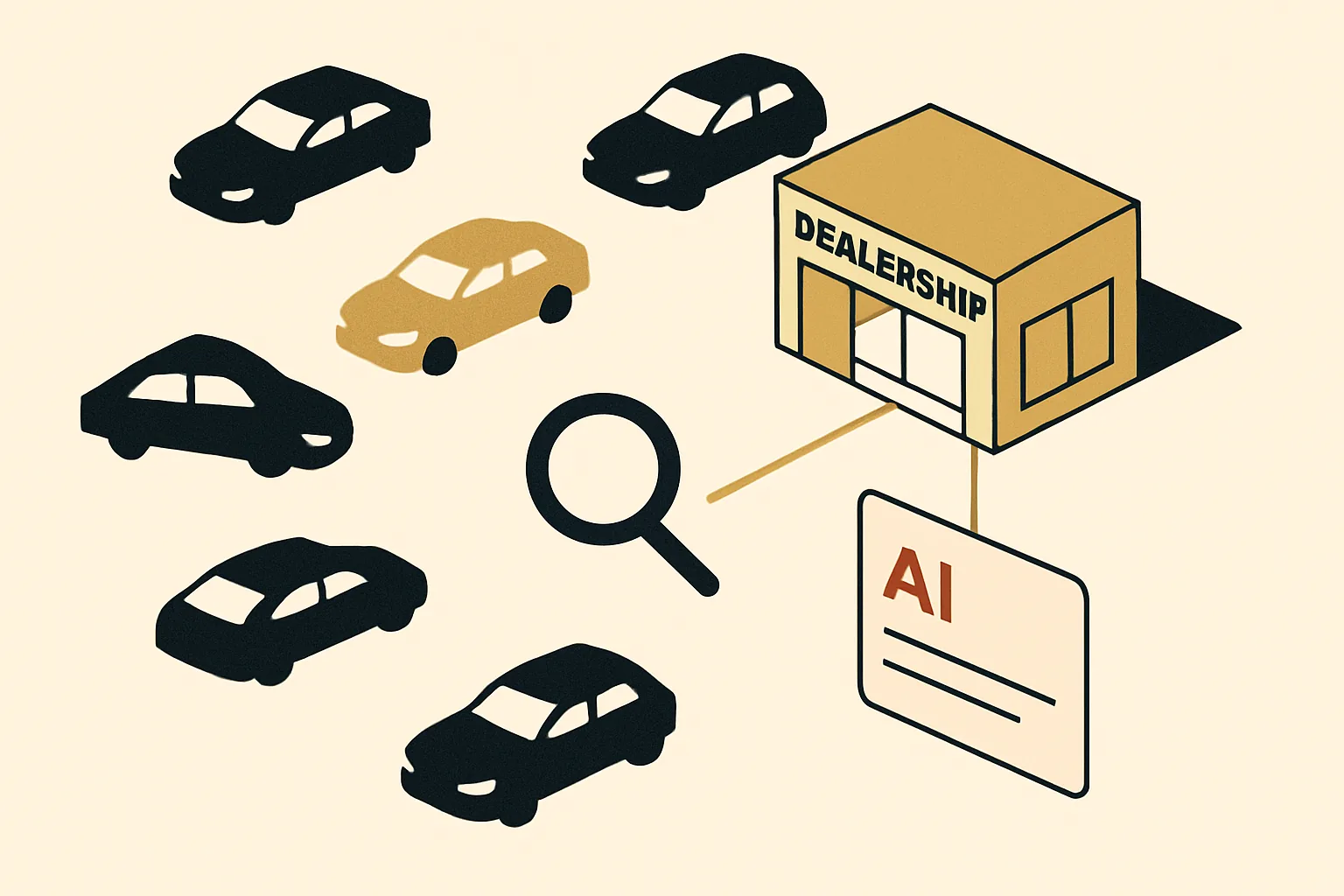
What the portals take and what they leave behind
Auto Trader and CarGurus give your stock visibility on their platforms at their rates. The margin on every unit sold through a portal is smaller than the margin on a direct enquiry, and the buyer relationship belongs to the platform, not to you.
The buyers ready to discuss finance, part-exchange or a specific model often start before they open a portal. They search Google for “used BMW 3 Series [town]”. They ask an AI assistant which dealer to visit. At each moment, a dealership with no owned presence is absent.
The portals solve stock visibility. They do not make you a named, trusted dealer in your area.
What decides whether a buyer finds you directly
Direct enquiries come from three sources the marketplaces do not own:
- Local model-specific search. When a buyer searches “Toyota Yaris dealer [town]” or “approved used Golf near me”, Google’s results are dealership websites, not portal listings. A well-structured site with fresh stock data and strong local signals earns those clicks without paying per-lead. That is the foundation of web design for car dealers done properly.
- Finance and part-exchange intent. Buyers searching for a finance calculator or a part-exchange valuation are signalling serious purchase intent. A site built around those conversions turns that intent into an enquiry rather than returning them to a portal.
- AI engine recommendations. When someone asks ChatGPT or Perplexity for a dealer to visit, the answer is assembled from your whole footprint: your site, your reviews and your third-party mentions. Our AI visibility work measures where you stand in those answers and works to close the gap.

The digital mistakes that lose direct enquiries
A handful of patterns show up consistently on dealer sites that underperform:
- Stock pages without structure. A raw feed from your dealer management system is readable to a human but not reliably readable to a search engine or AI engine. Correct vehicle schema, clean URLs per make and model, and consistent pricing data make the difference.
- No local content. “Used cars in [town]” is a real search. A location page built around your area, the makes you stock and the services you offer captures that intent. A site with only a stock feed does not.
- Missing finance and valuation paths. Finance is where the margin lives. Buyers who land on a stock page without a clear part-exchange or finance call to action leave without converting, even when they were ready to act.
- No review strategy. Review velocity affects local Map Pack rankings and the signals AI engines use to assemble dealer recommendations.
The question your buyers now ask twice
A buyer considering a car asks “which dealer should I visit?” twice in the same week: once through a search engine, once through an AI assistant. Both answers are shaped by your digital footprint, not your ad spend. A Tell us about your business measures both: where you rank for the model-specific and local searches that matter, and which AI engines name your dealership rather than a competitor’s.
The second question is asked in a place you cannot see. The answer is set by work done before the buyer ever types a query.
How we measure dealership visibility
We do not open with a redesign. We open with a Diagnostic: a measured baseline of where your dealership stands across Google local, model-specific search terms and AI engine recommendations in your area. That baseline shows what your nearest competitors are capturing that you are not, and which changes will move enquiry volume rather than just rankings.
From there, our SEO work builds the organic presence and our AI visibility work closes the gap between what you say about your dealership and what the AI engines say. Progress is measured against the same baseline every cycle.

Where to start
Tell us about your business. We measure where your dealership stands across Google and the AI engines, show you what your direct-enquiry opportunity looks like in your area, and set out the specific work that will move the numbers. You see the evidence before you commit to anything ongoing.