Marketing for Recruitment Agencies That Works in Both Directions

Recruitment agencies operate a two-sided market. You need candidates to find you and employers to trust you. We help UK agencies get found across Google and AI search, so both audiences reach you before they reach a competitor.

Request a visibility briefing
The problem

How Recruitment agencies lose enquiries today.

Most recruitment agencies grow on referrals, LinkedIn activity and job-board spend, then hit a ceiling. Employers shortlist the agencies that turn up when they search. Candidates apply through whatever job board appears first. The agency is doing excellent work but is invisible to the people who would choose it on merit, because neither side can find it without a referral or a LinkedIn connection.

The shift

Are you the answer when AI gets asked?

Hiring managers now ask ChatGPT and similar engines which recruitment agency specialises in their sector before they search Google. If a hiring manager asks an AI engine for the best tech recruiter in London, or the most trusted healthcare staffing agency, a short list comes back with named agencies. Yours, or not. We work to make sure your agency is the one that gets named.

What we do for Recruitment agencies

One partner. The full picture.

We cover your search presence end to end, so enquiries land on one site that the search engines and the AI engines both trust.

01

Recruitment Agency Marketing

Lead-generation and employer-brand campaigns built for the two-sided market, so the right employers and the right candidates find you at the same time.

02

Recruitment SEO

Search-optimised pages built around the sector-specialist searches employers actually run, so you earn qualified inbound enquiries without paying for every placement.

03

AI Visibility

We track how AI assistants describe and recommend your agency, then work to make sure you are the named specialist when a hiring manager asks.

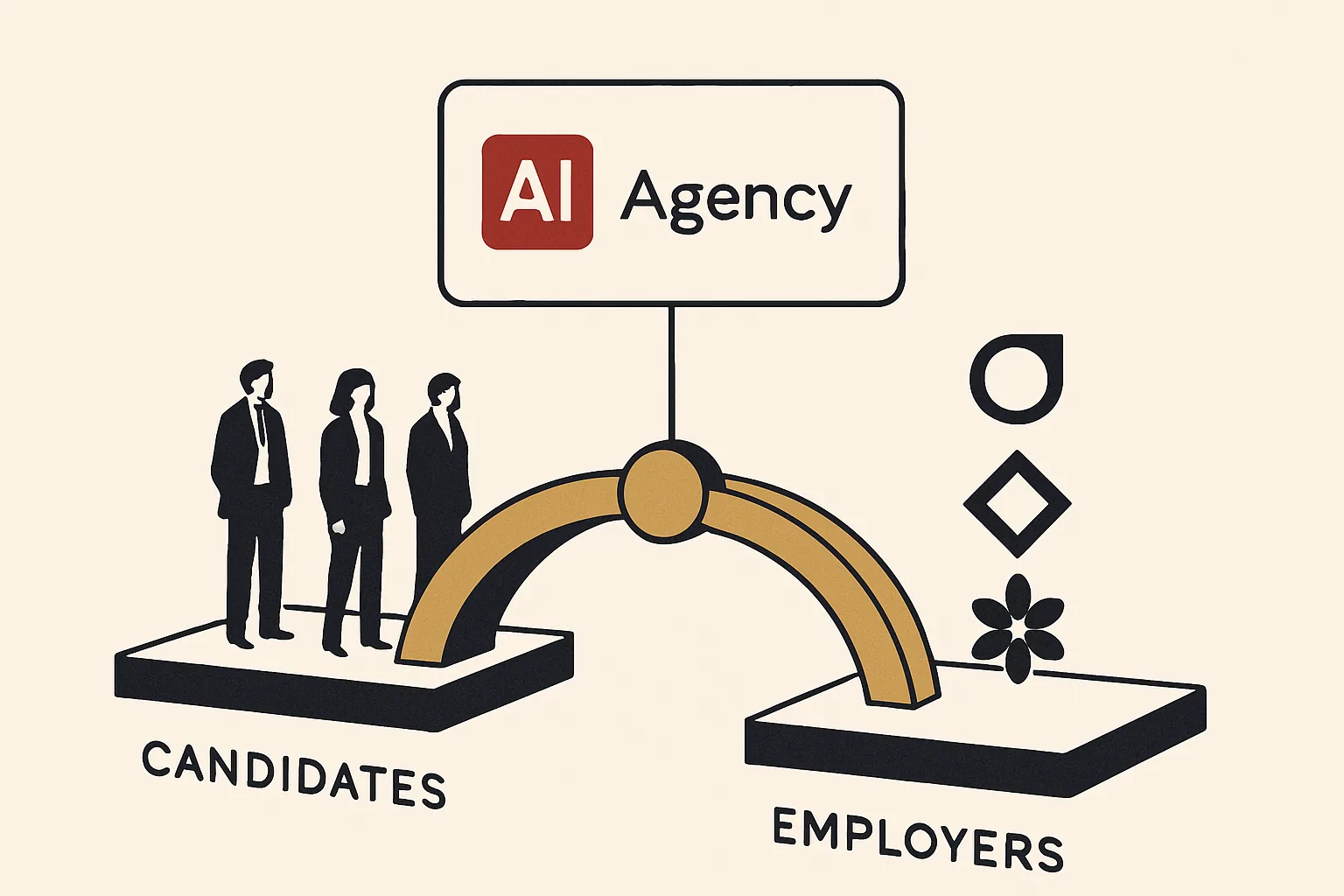
An abstract bridge linking candidates to employers, with a recruitment agency named at the centre by an AI answer.

Why recruitment agencies are harder to find than they should be

Recruitment agencies sit in an unusual position. The business runs on relationships and referrals, and the placement record is strong. But the moment a hiring manager at a firm that has never worked with you searches for a specialist recruiter in your sector, the referral network does nothing. The search result, and increasingly the AI answer, decides who gets the call.

That is the two-sided visibility problem most agencies have never had to solve. You compete for two audiences at once: employers who need to trust you before they brief you, and candidates who choose which agency to register with based on what turns up when they search their field. Job-board spend and LinkedIn keep the pipeline moving short-term. Neither builds the structural visibility that earns inbound enquiries from either side. Effective marketing for recruitment agencies has to work in both directions at the same time.

What decides whether a hiring manager finds your agency

Recruitment search is more specific than most sectors. A hiring manager looking for a finance recruiter in Manchester is not searching “recruitment agency”. They are searching “finance recruitment agency Manchester”, or asking ChatGPT which firms place qualified accountants in the North West. Those two surfaces, the traditional results page and the AI answer, return different sets of names, and both matter.

Three things decide whether your agency appears:

  • Sector-specific positioning. A generalist page does not rank for specialist searches. An agency placing tech contractors, executive finance professionals and healthcare staff needs a separate, clearly structured page for each practice area, in the terminology that sector uses rather than agency jargon.
  • A site search engines can read. Clear structure, fast load times, and content a crawler can index without confusion. This is the foundation of our web design work.
  • An AI footprint built over time. The AI engines pull from your whole presence: your site, your reviews, your mentions in trade press and sector directories. Our AI visibility work finds where that footprint has gaps and closes them.

Three stacked layers showing site structure, content and AI trust for a recruitment agency.

The two channels most agencies overlook

Job boards like Reed, Indeed and CV-Library carry much of the candidate volume; LinkedIn carries the employer relationship work. Both are useful. Neither builds an owned channel that compounds.

When a hiring manager who found you through a LinkedIn post later validates your agency on Google, what do they see? A thin site with a generic home page and a jobs feed, or a site that clearly states your specialism, your sector depth, and why your candidates land faster in roles like the one they are filling? The second version converts a warm referral into a briefed mandate, and a cold search into a first conversation. SEO for recruitment agencies builds it: sector-led pages, credibility signals from your placement history, and content that earns the ranking your LinkedIn presence cannot deliver alone.

Why AI visibility matters for recruitment now

When a hiring manager asks ChatGPT which agency to use for mid-level tech hires in London, the answer is assembled from every signal that engine can find: reviews, sector content, third-party mentions, and the authority of the domains that reference you. All of it feeds into which three or four names come back.

This is the gap we explain in why your business appears in Google but not ChatGPT. For recruitment the stakes are higher, because the buyer is a time-pressed hiring manager with a live mandate who trusts the AI shortlist over a directory. If you are not named, a question you never knew was asked costs you the brief.

How we measure recruitment agency visibility

We do not open with a strategy document or a rebuild proposal. A Visibility Briefing measures where you stand: which sector-specialist searches return your agency, which do not, and how often the AI engines name you when a hiring manager asks for a specialist in your space. That baseline becomes the scorecard we report against every quarter. The principle, set out on our methodology page, is simple: measure first, advise second.

A visibility meter rising from search to an AI answer card for a recruitment agency.

Where to start

A Visibility Briefing shows where your agency stands across Google and the AI engines, what your closest competitors are capturing that you are not, and the specific changes that will move your enquiry pipeline. You see the evidence before committing to anything further, and exactly which hiring managers and candidates are currently finding someone else.

Proof

Evidence, not promises.

Every Qyliq engagement starts with a measured baseline of where you stand across Google and AI search, and ends with a measured result. We show you the working at every step.

Related case study

MOUVE dance school

Read the full case study
Questions

What Recruitment agencies
ask us

Straightforward answers. If yours is not here, ask us directly.

Why does my recruitment agency website get traffic but no enquiries?
Traffic is not the product. Briefed mandates are. Most agency sites are built like brochures. They describe the firm and list services, but they give a time-pressed hiring manager no reason to start a conversation, and they are structured around candidates rather than the employers who actually pay. A Visibility Briefing shows where the visitors are leaking away, and what the site needs to turn a search or a referral into an enquiry.
How do recruitment agencies win new clients now that cold outreach has stopped working?
Cold email and LinkedIn outreach still have a place, but hit rates have fallen as every hiring manager's inbox fills with near-identical messages. The agencies still growing have built an inbound channel that keeps producing enquiries when they are not prospecting. It comes from sector-specific pages that rank for the searches employers actually run, and an AI footprint that gets them named when a hiring manager asks an engine who to use. We build that channel so your pipeline does not rest on outreach volume alone.
Why doesn't ChatGPT recommend my agency, and how do I get cited in AI answers?
AI engines assemble their answer from everything they can read about you online. Your site, your reviews, your sector content, and your mentions in trade press and directories all feed it. If your specialism is not stated in a form a machine can parse, or your strongest content sits behind a form it cannot read, the engine has nothing to cite and names a competitor instead. Our AI visibility work finds those gaps and closes them, so your agency is in the answer when a hiring manager asks.
How do I check whether my agency already appears in ChatGPT, Perplexity and Google AI Overviews?
You can run a rough test yourself in minutes. Open each engine and ask the question a hiring manager in your niche would ask, across five or six phrasings, for example the best fintech recruiter in London or a specialist healthcare staffing agency near you. Note whether you are named, which competitors are, and what the engine says about each. A Visibility Briefing does this systematically and turns it into a baseline we measure progress against.
Can a small or boutique agency really compete with Hays and Reed in Google and AI search?
Yes, and often more easily than competing with them on brand spend. The large consultancies win broad, generic searches. A specialist agency wins on depth in a narrow niche, where a clearly structured page and genuine sector authority beat scale. AI engines reward that specificity too, because a precise match to a niche query is more useful than a generalist name. We build the sector depth and the signals that let a focused agency outrank far larger firms where it counts.
My salary guide is behind a gated form. Is that hurting my SEO and AI visibility?
Often, yes. A gated PDF generates leads, but search engines and AI engines cannot read what sits behind a form, so your best content earns you nothing in the results or the AI answer. The fix is not to give it all away. It is to publish an open, well-structured summary the engines can read and cite, and keep the full download gated for lead capture. You get the citations and the leads, rather than choosing between them.
Do you work on candidate attraction as well as client acquisition?
Yes, and the two require different approaches. Candidate attraction is largely local and role-led, driven by search and job-board presence. Client acquisition is relationship-led but increasingly researched online first. A Visibility Briefing maps both sides, so we work on what will actually move your business.
How much should a recruitment agency spend on marketing, and what return is realistic?
There is no single right number, and any agency that quotes one before looking at your site is guessing. What matters is the cost of winning one new client against the lifetime value of the mandates that client brings, which in recruitment is usually high. We start with a Visibility Briefing so spend is set against the specific gaps that are costing you enquiries, not a generic percentage of turnover. You see what each pound is meant to move before you commit.
Next step

Find out where you stand

The Visibility Briefing maps your current position across Google and AI search with evidence, not guesswork. See where you stand before committing to anything.

Request a visibility briefing