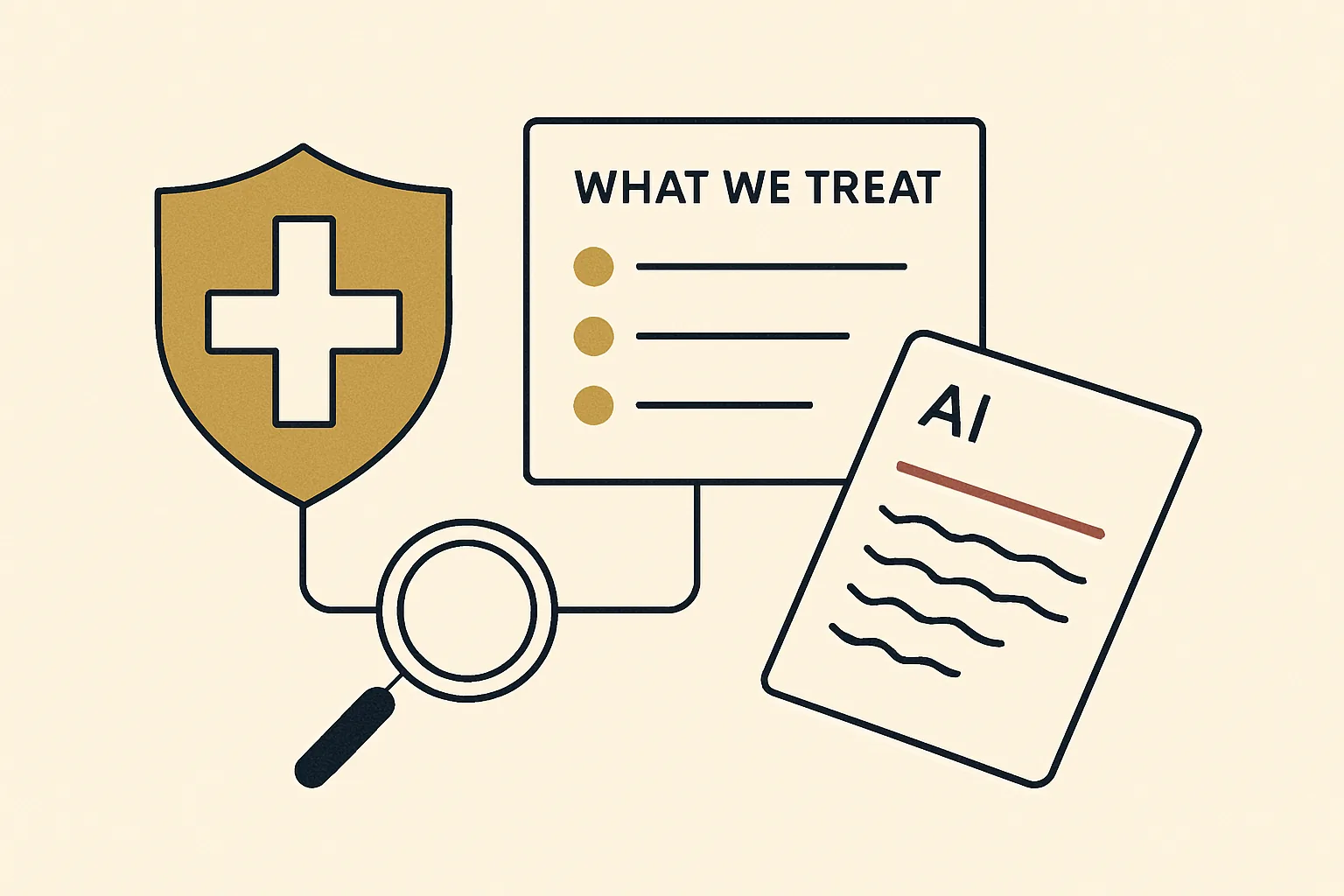
Marketing for Private Clinics That Earns Patient Trust

Private healthcare is bought on trust. Patients research online before they ever call, and AI engines name a shortlist before they ever reach a search results page. We help UK private clinics get found safely, compliantly, and confidently across both.

Request a visibility briefing
The problem

How Private healthcare clinics lose enquiries today.

Most private clinics face a structural problem with how they present online. The advertising rules are tight, CQC registration shapes what can be said and how, and the instinct is to say as little as possible. The result is a site that is cautious to the point of being invisible. Patients searching for private care cannot tell what the clinic treats, what it costs, or whether to trust it, and so they move on to whoever answered those questions clearly.

The shift

Are you the answer when AI gets asked?

Patients increasingly ask AI engines, such as ChatGPT, Perplexity and Google AI Overviews, where to get a specific treatment privately before they open a single search result. Those engines return a short, named list. A clinic that is not on that list does not get called, and it never sees the enquiry it missed. We work to make sure compliant, well-structured clinics are the ones named in those answers, not bolder competitors who are less careful.

What we do for Private healthcare clinics

One partner. The full picture.

We cover your search presence end to end, so enquiries land on one site that the search engines and the AI engines both trust.

01

Private Clinic Web Design

Clear, trustworthy sites built around the patient journey, showing what you treat, what you do not treat, and how to take the next step, structured so every service page can be found, indexed and trusted.

02

Healthcare SEO

Service and condition pages optimised for the terms self-pay patients actually search, with compliant copy that earns rankings without running into CQC or ASA constraints.

03

AI Visibility for Healthcare

We track how AI engines describe and recommend your clinic, then work to make sure patients asking about private treatment in your area are given your name.

A private clinic surfaced safely and compliantly across search and AI.

Why cautious marketing becomes invisible marketing

Private healthcare operates under tight constraints. The Care Quality Commission regulates the services, the ASA governs what can be claimed about outcomes, and where doctors are involved, GMC guidance shapes what can be said about individuals. The instinct, reasonably, is to stay conservative: say less, risk less.

The problem is that a conservative online presence and an invisible one look identical to a patient searching for private care. A site that does not state what the clinic treats, what a first appointment involves, and roughly what it costs is not being careful. From the patient’s side, it is not answering the question, so they move on.

The clinics that get this right do not overclaim. They structure their content so a patient looking for a specific treatment finds a clear answer: what you treat, what falls outside your scope, how to book, and what to expect. That structure is also what search and AI engines need to surface you.

What decides whether a private clinic surfaces in search and AI answers

When a patient asks an AI engine where to get private treatment, it draws on everything publicly available about your practice: your website structure, your service descriptions, your patient reviews, and how you are mentioned across third-party directories and clinical listings. Three things decide whether you appear in that answer:

  • Compliant, clear service pages. Each treatment or service area needs its own page explaining what you offer, who it is for, and what the process looks like. This is the web design and content work that underpins everything else.
  • Search-optimised condition and treatment content. Patients search for symptoms and conditions before they search for clinics. Pages built around the terms they actually use, written within what your registration allows, earn rankings without regulatory risk. That is the core of healthcare SEO.
  • A consistent, trusted presence across platforms. Reviews, directory listings, and third-party citations all feed the AI engines reading your footprint. Our AI visibility work measures that picture and finds the gaps.

Three stacked layers showing site structure, content and AI trust for a private clinic.

The question your patients now ask twice

A patient looking for private care asks “who should I trust with this?” at least twice: once when they first search online, and once when they ask an AI engine the same question minutes later. Those two places increasingly return different answers. The first pulls from search results; the second names a short list assembled from everything available about your practice and your competitors.

If your clinic is present and well-structured in both, you are on the shortlist both times. If not, you are absent from the second conversation entirely, with no way of knowing how many patients are having it. This asked-twice reframe shapes how we approach every private clinic engagement, and the Visibility Briefing shows what both conversations currently look like for your practice.

The Elstree Urgent Care engagement

Our work with Elstree Urgent Care, a CQC-registered urgent care centre in Hertfordshire, shows what structured positioning looks like in a regulated health setting.

The engagement built compliant, clear content across every service area: stating explicitly what the centre treats, what falls outside its scope, and who the clinical team is, so patients in genuine need find the right information fast, without overclaiming or making promises the centre cannot back up.

That positioning work, grounded in the CQC registration number and the clinical reality of what urgent care provides, earns patient trust and AI engine trust at once. It is not a marketing layer; it is an honest description of what the clinic does, structured to be found. See our case studies and methodology.

How we measure visibility for private clinics

We do not start by redesigning your site. We start with a Visibility Briefing: a measured baseline of where your clinic ranks for the service terms your patients search, how the AI engines describe your practice, and where competitors are named instead of you. For regulated health businesses, it also covers how clearly your service scope reads and whether your content answers the questions patients bring to search and AI engines.

A visibility meter rising from a search result to an AI answer, showing a private clinic becoming named.

Where to start

The Visibility Briefing is the right first step. It shows where your clinic stands across search and AI, what your nearest competitors are capturing, and the specific changes that will move your visibility, within the bounds your registration and advertising rules allow.

Request a Visibility Briefing to see the evidence before you commit to anything ongoing.

Proof

Evidence, not promises.

Every Qyliq engagement starts with a measured baseline of where you stand across Google and AI search. For regulated healthcare, that includes how your clinic is described, how clear your service scope is, and where the AI engines name competitors instead of you.

Related case study

Elstree Urgent Care

Read the full case study
Questions

What Private healthcare clinics
ask us

Straightforward answers. If yours is not here, ask us directly.

Can private clinics market themselves online given the advertising rules?
Yes, with the right structure. CQC registration, clear service descriptions, and compliant what-we-treat framing are trust signals, not constraints. The clinics that get this right build patient confidence before the first call. The ones that get it wrong either say too little and go unfound, or overclaim and attract regulatory attention. We understand the difference.
How does AI search affect patient acquisition for private clinics?
Patients now ask AI engines which clinic to use before they look at a search results page. Those engines read everything publicly available about your practice, your reviews, your service descriptions, and your third-party mentions, then name a short list. If your clinic does not have clear, structured, trustworthy content across those surfaces, it does not get named. A Visibility Briefing shows you exactly where you stand.
Does Qyliq work with regulated health businesses?
Yes. Our work with Elstree Urgent Care, a CQC-regulated urgent care centre, focused on compliant positioning, clear service scope, and building the kind of online presence that earns patient trust without making claims the practice cannot stand behind. That experience shapes how we approach every health sector engagement.
How do you measure results for a private clinic?
We set a measured baseline at the start covering search rankings for your key service terms, how the AI engines describe your practice, and where competitor clinics are named instead of you. We report against that same baseline every cycle. Progress is documented, not described.
Next step

Find out where you stand

The Visibility Briefing maps your current position across Google and AI search with evidence, not guesswork. See where you stand before committing to anything.

Request a visibility briefing