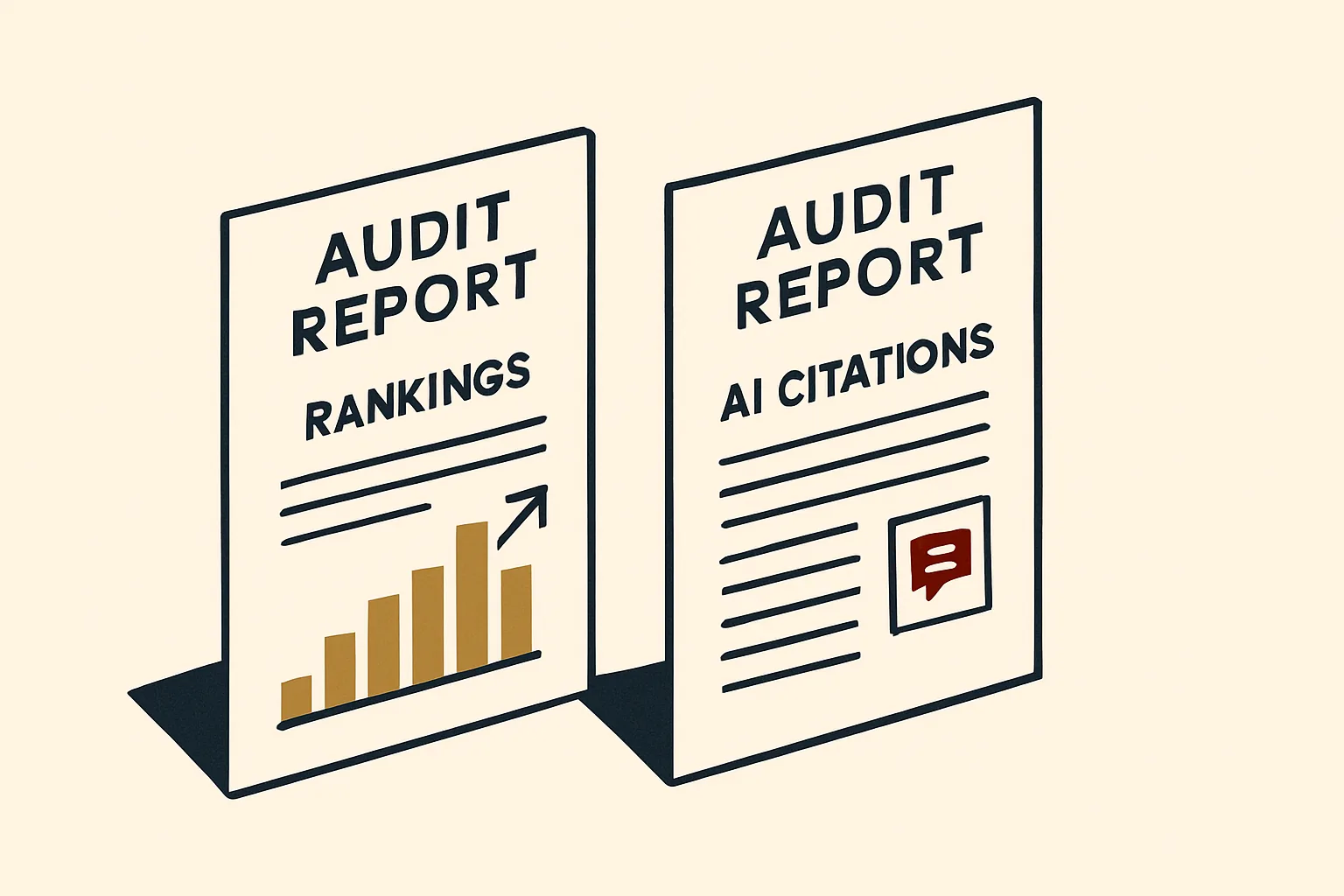
You can run a full traditional SEO audit on your website, come back with a clean score, and still not appear once when a potential customer asks ChatGPT who to call in your sector. That is not a failure of the audit. It is a measurement gap: the two types of audit look at different things, serve different questions, and produce results that do not translate across.
An AI visibility audit measures whether the major answer engines recommend your business by name. A traditional SEO audit measures whether your web pages rank on Google. Both matter. But they are not the same, and knowing which gap you are actually trying to close changes where you start.
What a traditional SEO audit covers
A traditional SEO audit is a diagnostic of your website’s performance in ranked search results. It measures the signals Google and Bing use to decide where to place your pages.
The core checks are well established:
- Keyword rankings. Which pages rank for which search terms, and at what position.
- On-page signals. Title tags, meta descriptions, heading structure, and whether your content addresses the search intent for the terms you are targeting.
- Backlink profile. The number and quality of external sites linking to yours, which remain a significant factor in ranking authority.
- Technical health. Site speed, crawlability, mobile usability, duplicate content, broken links, and Core Web Vitals.
- Content gaps. Search terms your audience uses where you have no page, or where your existing content is thin relative to what ranks.
A well-executed traditional SEO audit is genuinely useful. It tells you why a page is not ranking, which technical barriers are costing you search visibility, and where you can capture search traffic you are currently missing. The problem is not that these audits are wrong. It is that most SEO audits stop short of the question that now decides who gets the call.
What a traditional SEO audit does not tell you is anything about your AI citation rate. It cannot, because the signals that predict citation by an answer engine are largely different from the signals that predict a search ranking.
What an AI visibility audit covers
An AI visibility audit starts not with your website, but with the questions your customers are actually asking of the engines they now use to find businesses.
The process is direct: run the queries your buyers use, record what the engines say, and measure the result.
- Citation rate across engines. How often does your business appear by name when ChatGPT, Claude, Perplexity and Google AI Overviews answer a relevant buyer question? That share is your baseline.
- Competitor map. Which businesses are named when you are not? How consistently are they cited, and in what terms?
- Entity clarity. Is your business described consistently and accurately across the sources the engines use? Contradictions between your website, directories and reviews make an engine hesitant to name you.
- Third-party corroboration. Does the wider web mention your business in a way an engine can trust? Reviews, articles, directory listings, and structured data all contribute to the picture.
- Content structure for answer extraction. Is your site organised so an answer engine can extract a clear, quotable description of what you do and where you operate?
The output of an AI visibility audit is not a list of rankings. It is a citation rate: the share of buyer queries on which you are recommended. If that number is zero, or single figures, you are invisible to the engine your customer may already be using to decide who to call.
Why the two audits diverge in practice
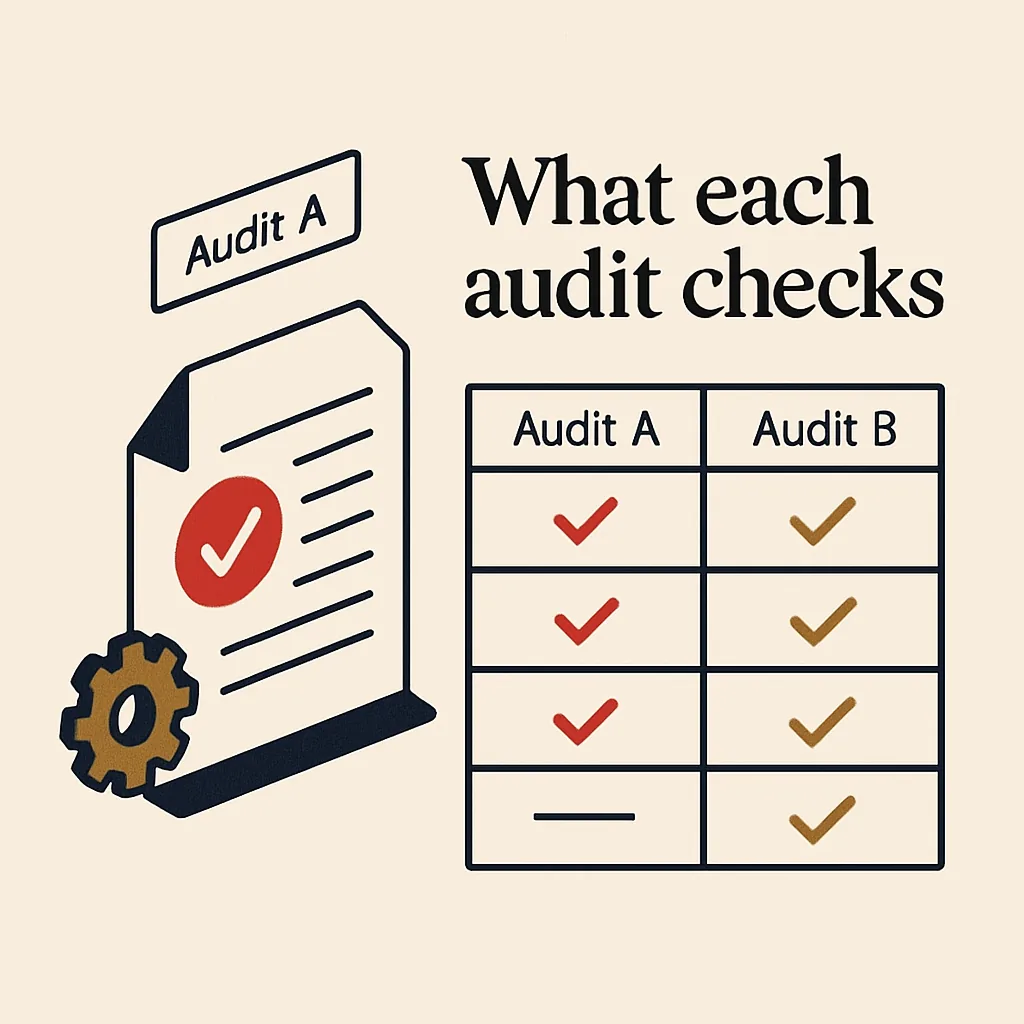
The divergence comes down to how each type of engine works.
A search engine ranks pages. It asks: “Which page on the web best matches this query?” Your ranking is a score for a specific URL on a specific term. Improve the page, earn links, fix technical issues, and the ranking moves.
An answer engine recommends businesses. It asks: “Which business should I name in this answer?” That is a different question with different inputs. The engine draws on your website, but also on your review profile, directory listings, third-party mentions, and any structured data that describes your business in machine-readable terms. It is looking for a consistent, well-corroborated entity it can name without risk.
This is why strong traditional SEO performance does not automatically transfer to AI citation. A page can rank at position one for a competitive term while the business behind it has conflicting information across directories, thin third-party mentions, and no structured data that clarifies what it does and where it serves. That business will rank well and still be invisible to an answer engine that cannot confidently build a picture of it.
The reverse is also possible. A business with a modest Google presence but a clean, consistent, well-corroborated footprint can be named by ChatGPT ahead of a larger competitor with better rankings and a messier entity profile. The question asked twice, once by you when you describe your business, and once by the engine when it reads the wider web, does not always have the same answer.
The measurement gap most businesses have not noticed
The question your buyers are asking of AI engines right now is “who should I call for this?” Three to five names come back in the answer. Most businesses have never measured how often their name is one of them.
Traditional SEO reporting does not capture this. Search Console tracks clicks from Google. Rankings tools track keyword positions. Neither records citation frequency across ChatGPT, Claude or Perplexity, because those engines do not pass referral data in the conventional way. The traffic that never clicked does not show up in any analytics dashboard. The customer who asked Perplexity, received three names, and called the first one without ever visiting a website is entirely invisible to your existing reporting.
This is not a small surface area. As AI-assisted search grows as a channel for service discovery, the gap between your search ranking and your citation rate is a gap between your measured visibility and your actual visibility in the market. The Diagnostic is designed to close that measurement gap before you commit resources to closing the citation gap.

Which audit to prioritise
The answer depends on where your customers are looking, and what problem you are actually trying to solve.
If a customer in your sector would type a query into Google, scroll through a list of links, and click through to compare options, a traditional SEO audit is the right starting point. Keyword visibility, page-level optimisation, and technical health are the levers to pull.
If a customer in your sector would ask ChatGPT or Perplexity “who is the best firm for this in [location]?” and call the first or second name that comes back, your citation rate across those engines is the number that matters. A traditional SEO audit cannot tell you what that number is, nor what is causing it to be low.
For most professional and local services, the honest answer is that both gaps exist and both matter. But they are closed in different ways, and often in a different order than you might expect. The Diagnostic starts with measurement across both surfaces: what the AI engines say about you today, and where your search presence compounds the AI citation problem. That measure-first sequence, baseline before any work, is the spine of our methodology.
How to measure both without starting from scratch
The starting point for both audits is the same: establish a baseline before doing any work.
For search: record your current rankings for the terms that matter, not every term you could theoretically target, but the terms your actual buyers use when they are ready to hire someone.
For AI citation: run the buyer questions across ChatGPT, Claude, Perplexity and Google AI Overviews. Record whether you are named, where in the answer, and which competitors appear instead. That is your citation rate baseline. You cannot improve a number you have not measured, and the methodology behind that measurement is documented in detail in our guide on how to track AI visibility.
The two measurements together give you a complete picture of where you stand, which channel is underperforming, and what the priority is. The Diagnostic does this across both surfaces and hands you the findings before you decide whether to do anything about them.
If you have run SEO audits before and still found your business missing from AI-assisted searches, the gap is not in your website. It is in the measurement. A Diagnostic gives you both numbers, the citation rate and the search gaps, and tells you in plain language what is costing you recommendations.
Tell us about your business and we will run the audit across your sector, map where your competitors are being named instead of you, and show you exactly what the engines currently say about your business.
Frequently asked questions
Can a traditional SEO audit tell me whether I appear in ChatGPT or Perplexity?
No. A traditional SEO audit measures your performance in ranked search results: keyword positions, on-page signals, backlinks, site speed and crawl health. None of those metrics track whether ChatGPT, Claude or Perplexity name your business in their answers. For AI citations you need an AI visibility audit that queries those engines directly and records what they say about you.
Do I need both audits, or just one?
For most businesses, the answer depends on where your customers are looking. If your customers are asking AI engines who to call, which is increasingly common for professional and local services, then an AI visibility audit is the higher-priority measurement. A traditional SEO audit remains useful for diagnosing technical barriers and keyword gaps, but it tells you nothing about your citation rate across the engines your buyers now use.
What does an AI visibility audit actually measure?
An AI visibility audit queries the major answer engines, including ChatGPT, Claude, Perplexity and Google AI Overviews, with the questions your customers are likely to ask. It records whether your business is named, where in the answer it appears, what is said about you, and which competitors are named instead. The result is a citation rate: the share of relevant queries where your business is recommended.
Why does my Google ranking not predict my AI citation rate?
Because search engines and answer engines reward different things. A search engine ranks the page that best matches the query. An answer engine recommends the business about which it has the clearest, most consistent, most corroborated picture across the whole web: website, reviews, directories, structured data, and third-party mentions. You can hold a strong ranking and still score zero on AI citations if the wider evidence about your business is thin.
How often should an AI visibility audit be repeated?
Quarterly is the right rhythm. The major engines re-index the web on their own schedule, and their recommendations change as new information lands. A quarterly Diagnostic establishes your baseline, tracks whether previous work has moved your citation rate, and identifies the next priorities before competitors close the gap.
What does Qyliq's Diagnostic include?
The Diagnostic audits what the AI engines and search results currently say about your business across all four major engines. It measures your citation rate on the buyer questions that matter, maps the gaps against named competitors, and tells you which improvements to prioritise before you commit to any ongoing work. It is diagnostic, not a sales call.