The landscape of how customers find businesses has split. There is the search engine they have always used, and there is the growing set of AI search engines that answer questions differently: not a list of pages to scroll through, but a short answer with a handful of named businesses inside it. If your business is not in that answer, the customer never sees you. They call the ones that are named.
This guide covers the AI search engines that matter for business discovery right now: what each one does, how it decides who to name, and what the pattern looks like across all of them. If you are trying to understand where to focus, or whether any of this applies to your business, this is the starting point.
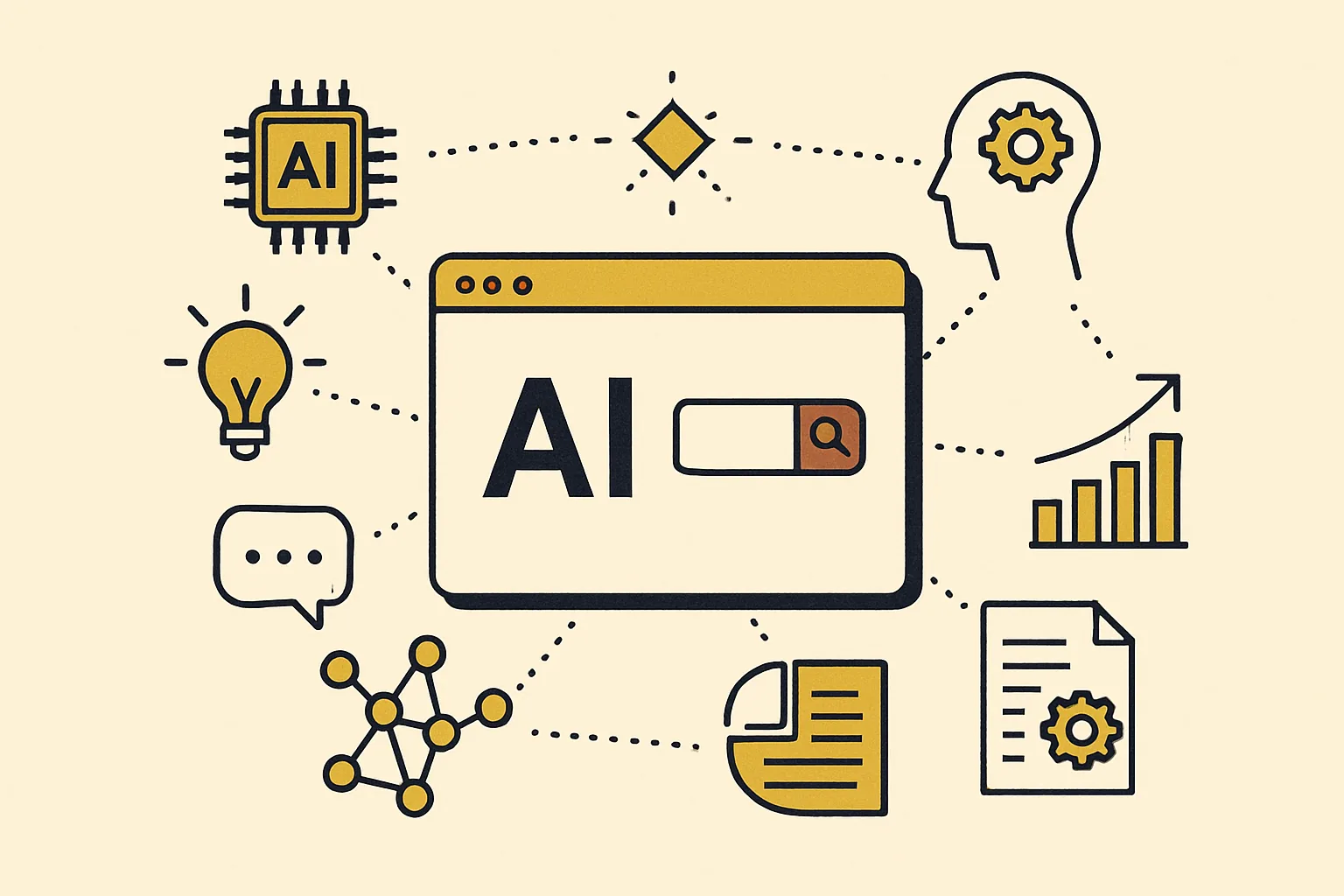
What makes an AI search engine different from Google
Google is a ranking engine. It crawls billions of pages, scores them, and returns a list of results in order. You click, you visit a page, you decide.
An AI search engine is a recommendation engine. It reads across many sources at once, assembles a picture of a topic or a category, and returns an answer. In that answer, it names businesses or services directly. The user does not click through a list. They read the answer and act on the names they see.
This distinction matters for a practical reason. In Google, visibility is a spectrum: you might rank first, tenth or fifty-eighth. In an AI answer, visibility is binary. You are named or you are not. There is no tenth place.
The question your potential customers are asking, whether aloud or typed, is something like: “who should I use for this?” That question is now answered in two places at once. Once by your own website and pitch, which you control. Once by an AI engine, which you do not control directly but can influence. The businesses that understand this are building their position in both places. The businesses that do not are visible in one and invisible in the other.
There is a deeper pattern here. The businesses that define how a category is understood are the ones the engines name. It is not about ranking for a keyword. It is about being the clear, consistent, corroborated answer to a category question.
The AI search engines that matter for business discovery
There are dozens of AI tools that touch on search in some way. For the specific question of “which engines might recommend your business to a potential customer”, five are worth understanding now.
ChatGPT
ChatGPT from OpenAI is the most widely used AI assistant and, for most business owners, the one they have heard of first. When a user asks ChatGPT a question that involves finding a business or service, it draws on a combination of its training data and, when the user has web browsing enabled, live web results via a search integration.
ChatGPT generates a prose answer. Within that answer, it names businesses when it has enough information to do so with confidence. If your business is described consistently across your website, your directory listings and the places that write about you, you give the model the material it needs to form a confident recommendation. If those sources disagree, or most of them say nothing at all, the model hedges or names someone else.
ChatGPT currently handles an enormous share of AI-assisted discovery queries in the UK. Any business that wants to be named by AI search engines starts here.
Perplexity
Perplexity is a real-time search assistant. Unlike ChatGPT, it performs live web searches for every query and builds its answer from the results it retrieves in that moment. It cites its sources inline, so the user can see where the answer came from.
For businesses, this means Perplexity’s recommendations are more volatile than ChatGPT’s, because they depend heavily on what appears in a live search at the time the question is asked. It also means that the quality and consistency of what appears in a search about your business, on your own site, on review platforms and in articles that mention you, directly shapes whether you are named.
Perplexity is growing particularly quickly among research-minded and professional users. A director comparing agencies or consultancies may well use Perplexity to shortlist before any call is arranged. Being cited in Perplexity’s answers is partly a function of having a well-structured web presence that a real-time search will surface, and partly a function of being mentioned by sources Perplexity trusts.
Claude
Claude is Anthropic’s AI assistant. For most consumer questions about finding a local or regional business, Claude currently relies on its training data rather than live web browsing, unless the user has a tool integration active. This means its business recommendations reflect what it was trained on and how consistently your business appeared in that training data.
Claude tends to be cautious about naming businesses it is uncertain about. This makes entity clarity, using consistent language to describe what you do, where you operate and who you serve, especially important. Vague or inconsistent descriptions across your web presence are more likely to produce hedging or silence from Claude than a confident recommendation.
Claude has a growing user base, particularly among technical and professional users. It is the third engine in the audits we run across all four.
Google AI Overviews
Google AI Overviews (previously Search Generative Experience) appears at the top of Google results for an expanding range of queries. Unlike the other engines in this list, it sits inside a product your customers may already be using daily.
For a business owner, this matters because AI Overviews can displace the traditional organic results that SEO has historically delivered. A user who gets a well-formed AI Overview at the top of the page may not scroll down to the blue links at all. If your business is named in the Overview, you get the recommendation. If your business ranks well in the organic results but is absent from the Overview, you get less of the click-through traffic that ranking used to guarantee.
Google AI Overviews draw heavily on the Google ecosystem: your Google Business Profile, your reviews, structured data on your site and the authority signals Google has gathered over years of indexing. This is one reason a complete and well-maintained Google Business Profile matters more now than it did three years ago.
Microsoft Copilot
Microsoft Copilot, formerly Bing Chat, is built on a combination of OpenAI models and Bing’s search index. For consumer queries it operates in a broadly similar way to ChatGPT with web browsing enabled. Its distinctive reach is in enterprise environments: Copilot is integrated into Microsoft 365, which means workers in large organisations may encounter it inside their existing tools rather than as a separate search product.
For businesses selling to other businesses, or to enterprise clients, Copilot is worth monitoring. A buyer researching a professional services firm from inside their corporate Microsoft environment may ask Copilot directly, without opening a separate browser search. Being visible in Bing search, maintaining a consistent and credible web presence, and earning third-party mentions that Bing indexes are the signals that flow into Copilot’s answers.
What all five engines have in common
The engines above differ in their architecture, their data freshness and their typical user. But when it comes to deciding which businesses to name, the underlying logic is similar across all of them.
Entity clarity. Each engine is trying to answer the question: does the web have a coherent, consistent picture of this business? What does it do? Where does it operate? Who does it serve? Vague positioning or clever copy that leaves a machine uncertain works against you.
Consistency across sources. If your website describes you one way, your directory listings describe you another way and your reviews mention a service you no longer offer, the engine cannot form a confident recommendation. Contradictions produce silence or hedging. Consistency produces recommendations.
Third-party corroboration. Engines weight information differently depending on whether it comes from you alone or from multiple independent sources. Your own website is a starting point. Reviews, directory listings, articles and mentions from sources the engine trusts add weight. A business described clearly and consistently in many places is easier for an engine to recommend confidently than a business that has only ever described itself.
Structured, readable content. Information that is laid out so a machine can extract it easily, with clear headings, specific answers to common questions and structured data that names your business, its category and its location, increases the chance that an engine can form a confident answer from your content. This is where Answer Engine Optimisation earns its place.
The pattern underneath all four signals is the same one we come back to in every Diagnostic we run: an engine is not judging whether you are the best business in your category. It is judging whether the web gives it a clear, agreed, well-evidenced picture it can repeat without risk. A smaller competitor with a consistent, well-corroborated footprint can be named ahead of a larger business that has never tended to its own.
Why your Google ranking does not automatically carry across
If you have invested in SEO and rank well on Google, it is tempting to assume that the AI engines will naturally find you and name you. The reality is more complicated.
A Google ranking confirms that one engine, using its own scoring signals, has placed your page highly for a specific query. AI search engines build their answers from a broader picture: your website, yes, but also everything else that the web says about you. They are not reading your ranking. They are assembling a picture from many sources and deciding whether that picture is coherent enough to recommend you.
Research into how generative engines handle business discovery, including work from Princeton on what content structures are most likely to be quoted by AI models, points consistently to the same findings: citations, authoritative sources, named evidence and clarity of structure influence AI outputs. None of those are the same as a keyword ranking.
You can win the ranking and still lose the recommendation. The businesses that understand this are not choosing between SEO and AI visibility. They are building both, because their customers now use both.
How to find out where your business stands
You do not need a specialist tool to take a first reading. The process is straightforward.
-
Write down the ten to fifteen questions a potential customer might ask when they are looking for a business like yours. Include questions about your service type, your location, and the problem you solve. “Who are the best [service type] in [your area]”, “I need a [service], who should I use”, “which [type of firm] should I trust with [problem]”.
-
Run each question through ChatGPT, Perplexity, Claude and Google AI Overviews. Use the same phrasing each time.
-
Record whether your business is named, where in the answer it appears, and what is said about you. Note which competitors are named where you are not.
What you are measuring is your citation rate: the share of relevant questions on which an engine names you. Most businesses that have never done this work find their citation rate is low or zero. That is your baseline. You cannot improve what you have not measured. There is a fuller walkthrough in our guide on how to measure AI visibility.
If running this across all four engines sounds like more time than you have, a Diagnostic does it systematically. We audit what ChatGPT, Perplexity, Claude and Google AI Overviews currently say about your business, compare it against your top competitors, and hand you the baseline with the priorities that would move the number. It is a diagnostic engagement, not a sales call.
What to do with what you find
The order of operations matters.
Measure first. Establish your citation rate before making changes. Without a before number, you cannot know whether any subsequent work is making a difference.
Fix the foundations. Address the inconsistencies in how your business is described across your website, your directory listings and your review profiles. Make your name, your service description, your location and your category consistent everywhere.
Earn corroboration. Build the third-party presence that gives engines more than one source to trust. Reviews, directory listings, industry mentions, written content that others might cite. Each additional consistent, credible reference makes your business easier to recommend.
Re-measure quarterly. The engines re-read the web on their own schedules. Changes you make today may take weeks to show up in their answers. A quarterly measurement rhythm, checking your citation rate across all four engines and comparing against competitors, is the sensible cadence. This is the basis of the quarterly evidence cycle we describe on the methodology page.
Building your position across the engines
The AI search engines covered here are not a passing experiment. They are becoming a significant channel through which potential customers find and shortlist businesses. The buyers who use them are not always typing the same queries they would type into Google: they are asking questions in natural language, expecting a direct answer, and acting on the names they see.
The businesses that are named consistently across these engines are not gaming a system. They are the ones that have made themselves easy to understand and easy to recommend: clear about what they do, consistent across every source, corroborated by the wider web, and structured in a way that machines can read.
A Diagnostic is the entry point. We audit your current position across the four engines, show you where you are named, where you are not, and what the gap looks like against the competitors who are being recommended in your place. From there, you decide whether to close the gap and at what pace.
If you are not sure where you stand, the place to start is finding out. Tell us about your business and we will show you exactly what the AI search engines are saying about your business right now.
Frequently asked questions
Which AI search engines should my business care about?
The four that matter most for business discovery right now are ChatGPT, Perplexity, Claude and Google AI Overviews. Between them they handle the overwhelming majority of AI-assisted queries where a customer is looking for a named business or service provider. Microsoft Copilot is a fifth engine worth watching, particularly if your customers work in enterprise environments where it is built into the tools they already use.
Do AI search engines rank businesses the way Google does?
Not in the same way. Google ranks pages and presents them as a list you scroll through. AI search engines build a short answer and name a handful of businesses inside it. There is no position two or position seven in an AI answer: you are either named or you are not. This is why the traditional SEO goal of 'ranking higher' does not translate directly to AI visibility.
Can my business appear in more than one AI search engine?
Yes, and that should be the goal. Each engine draws from slightly different sources and updates at slightly different rates, but the foundations that make a business recommendable, clear and consistent information across your website, directories, reviews and third-party mentions, help with all of them. Building a strong position in one engine tends to lift your position in the others over time.
Does having a Google Business Profile help with AI search engines?
It helps, particularly with Google AI Overviews, which draws heavily on the Google ecosystem. A complete, consistent and actively maintained Google Business Profile also signals entity clarity to the other engines, which index Google properties as part of their broader web reading. It is one piece of the picture rather than the whole answer.
How do I find out which AI search engines are already naming my business?
Ask each engine the questions your customers would ask: 'who are the best [your service] in [your area]', 'I need a [service], who should I use'. Run those questions through ChatGPT, Perplexity, Claude and Google AI Overviews. Record whether your business is named, where in the answer it appears, and what is said about you. That gives you a baseline citation rate across the engines. A Diagnostic does this systematically and hands you the gaps with priorities.
Is optimising for AI search engines the same as SEO?
Related, but distinct. Traditional SEO earns you a page ranking and a click. Answer Engine Optimisation (AEO), the practice of making your business visible to AI search engines, earns you a mention inside the answer itself. The underlying signals overlap: clear, well-structured content helps both. But AI engines place more weight on entity clarity, third-party corroboration and consistent information across sources than a traditional keyword ranking ever required.