How do AI search engines choose businesses? They read dozens of sources simultaneously before forming an answer. They are not ranking your page against other pages. They are building a picture of your business and deciding whether that picture is clear enough to recommend. A business with a tidy, consistent, well-corroborated footprint gets named. One with contradictory, thin or hard-to-read information gets passed over, however good the business actually is.
The short answer: AI engines choose businesses by looking for agreement. When your website, your directory listings, your reviews and independent third-party mentions all say the same thing about who you are, what you do and where you do it, the engine has a confident picture to repeat. When those sources disagree, or most of them say nothing at all, it names someone else.
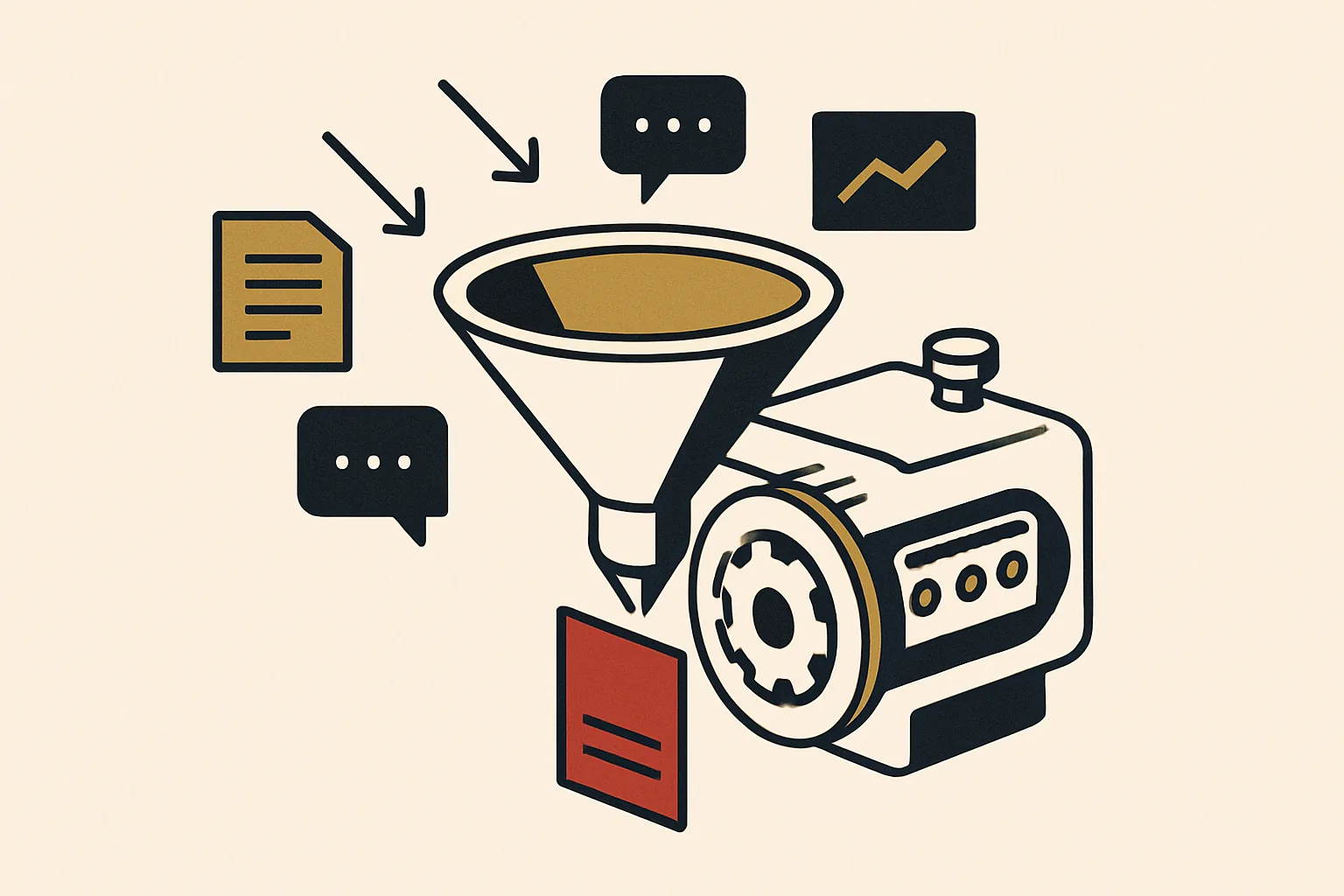
Why AI engines work differently from a search ranking
A traditional search engine answers a simple question: which pages match these words? It ranks a list of links and lets the person choose.
An answer engine, by contrast, answers a different question: which businesses should I name? It does not return ten links. It returns a short answer with a handful of businesses named inside it. That distinction has large consequences for how you need to think about visibility.
Google rewards page quality and keyword relevance. ChatGPT, Claude, Perplexity and Google AI Overviews reward business clarity. You can have the most carefully optimised page in your category and still be invisible to answer engines if the wider picture of your business is inconsistent or thin.
When a potential customer sits at their desk and asks an AI engine who to call, three to five businesses come back named in the answer. Yours, or not. You never see the question being asked. You only see its consequence: the enquiries that did not arrive.
The four signals that carry most of the weight
When an AI engine builds its shortlist, four categories of signal carry most of the weight. Understanding them tells you where to focus.

Entity clarity
Does the web state plainly what your business is, what it does and where it operates? “We help ambitious businesses reach their potential” tells a machine almost nothing. “An independent accountancy practice in Bristol specialising in construction and property businesses” tells it exactly what it needs. Vague or clever positioning copy can leave an engine genuinely unsure whether to class you as an accounting firm, a consultancy or something else entirely. When in doubt, it leaves you out.
Consistency across sources
Does your business name appear the same way on your website, your Google Business Profile, your directory listings and your industry registers? Is your service description the same across all of them? Even small inconsistencies, a slightly different trading name here, a service category that does not quite match there, introduce noise an engine must resolve. Most do not try. They name a business that gives them no ambiguity to resolve.
Corroboration from independent sources
An engine trusts a business more when other credible sources confirm what the business itself says. Third-party reviews, mentions in trade publications, links from professional associations, local press coverage, structured citations from directories: all of these tell the engine that the claim “this business exists and does this thing” is not coming from the business alone. The Princeton-led study on Generative Engine Optimisation (Aggarwal et al., presented at KDD 2024) found that content which cites external sources and carries third-party authority is significantly more likely to be cited by generative engines. The same pattern applies to business listings: the business the wider web independently confirms is the one the engine recommends.
Readable structure
Is your information laid out so a machine can extract it cleanly? Clear headings, explicit service descriptions, a file that tells AI crawlers who you are (an llms.txt file), schema markup that labels your business type, location and credentials: these are not cosmetic. They are the difference between an engine that can read you quickly and one that has to guess. Answer Engine Optimisation covers much of this ground, and it matters precisely because it removes ambiguity from the engine’s path.
Why consistency outranks excellence
This is the counterintuitive part. An engine is not judging whether you are the best business in your category. It is judging whether the web gives it a clear enough picture to name you without risk. A smaller competitor with a consistent, well-structured footprint can be named ahead of a larger, genuinely better business that has never tended to its own information.
Consistency across the whole footprint is the mechanism. An engine reads your website at the same time as your Companies House filing, your directory listings, your review platforms and the handful of trade articles that have mentioned you. If those sources agree on the core facts, it has a confident picture to recommend. If they contradict each other, even on small details, the engine hedges. Hedging in practice means naming someone else.

The implications are practical. A business that keeps its information consistent across every surface it occupies accumulates recommendation authority over time, not because an algorithm rewards it with a score, but because every source the engine reads points to the same unambiguous picture. That is a compounding advantage, and it is why method matters more than any single tool or tactic. Any business can update one directory listing. The ones that build a structural habit of consistency, auditing every surface and keeping it aligned quarter after quarter, are the ones that keep showing up named. A one-off optimisation pass, however thorough, does not sustain itself.
We have watched this play out. Working with MOUVE, a 25-year-old dance school in North London, a structured programme of exactly this kind took its ChatGPT visibility from zero to 92 per cent on the buyer questions that matter, and to 60 per cent across all four major engines combined, measured over 48 probes. The full audit and method behind that result are set out in our case studies.
How to check where you stand today
You do not need specialist software to get a first read. You need to ask the engines the same questions your customers ask.
Write down eight to twelve questions a potential customer would actually type, for instance “who are the best [your service] in [your area]” or “I need a [your service], can anyone recommend one.” Run each through ChatGPT, Claude, Perplexity and Google AI Overviews. Record whether you are named, where in the answer you appear, and whether what is said about you is accurate and consistent with how you describe yourself.
The result is a citation rate: the share of those questions where you appear. Most businesses that have never done this work score in the low single figures or at zero. That number is your baseline. There is a fuller walkthrough in how to measure AI visibility. If you have already noticed that your business appears on Google but not in AI answers, this audit is the natural first step.
From there, the priorities usually fall into a short list: which directory listings have stale or inconsistent information, where your service descriptions are vague, which review platforms have thin coverage, and whether you have any structured data or AI-readable file in place at all. The gap between where you are and where you need to be is almost always clearer than people expect once you have actually looked.
What to do once you know the gap
The work that closes the gap is the same across most businesses, even if the specific details vary.
Make the core description unambiguous. State what your business does, for whom and where, in plain language that a machine can extract. Not clever. Not clever-adjacent. Clear.
Audit every surface for contradictions. Your website, Google Business Profile, Companies House, industry directories, review platforms. Anywhere the web holds a record of you. Contradictions are the engine’s reason to hedge. Remove the contradictions and you remove its reason to leave you out.
Earn independent corroboration. Reviews, trade mentions, directory citations, professional association listings: these are not marketing tasks in the traditional sense. They are the third-party confirmation that turns a self-description into a verifiable claim. An engine that can confirm your description from multiple independent sources is one that can recommend you with confidence. There is a practical guide to the specific citation-building steps in how to get cited by ChatGPT.
Give machines a clean path in. Clear headings, explicit service labels, an llms.txt file, schema markup on your key pages. These reduce the work the engine has to do to understand you. Less ambiguity for the engine means more recommendations for you.
Re-measure after each round. The engines re-read the web on their own schedule. The changes you make today will take weeks or months to show up in citation rates. Measuring quarterly is the sensible rhythm. It also creates a record: what changed, what improved, what remains to fix.
How a Diagnostic fits in
A Diagnostic is Qyliq’s entry-point engagement. It runs this audit across all four major engines, maps where you are named and where you are not, identifies which of the four signal categories (entity clarity, consistency, corroboration, structure) is pulling your citation rate down, and hands you the findings in a briefing you can act on.
It is diagnostic, not prescriptive. You see the evidence before committing to anything ongoing. The gap between what the engines currently say about your business and what you would want them to say is almost always more specific and more fixable than people expect. A Diagnostic shows you exactly where that gap is.
If you want to understand how AI search engines are currently presenting your business to potential customers, Tell us about your business and we will show you where you stand. You can also read about the approach behind the audit on our methodology page.
The question your potential customers are asking of AI engines is being asked right now, without you seeing it. Knowing how those engines choose their shortlists is the first step to being on them.
Frequently asked questions
How do AI search engines choose which businesses to recommend?
They look for a clear, consistent, corroborated picture of your business across multiple independent sources: your website, directories, review platforms, articles and structured data. A business that is described the same way everywhere, with third parties who confirm the description, is one an engine can recommend with confidence. A business with thin, inconsistent or contradictory information tends to be left out.
Does having a great website guarantee you appear in AI recommendations?
No. A strong website is one signal, but AI engines read many sources at once. If your directory listings contradict your website, if reviews describe you differently from how you describe yourself, or if almost no third-party sources mention you at all, the engine does not have enough agreement to recommend you confidently. The website is the starting point, not the whole picture.
Why does my competitor appear in ChatGPT when I do not?
Almost always because the picture of their business across the web is clearer and more consistent than yours. They have the same name, services and location stated the same way in more places, with more third parties confirming it. The engine can recommend them without hedging. The gap is usually not about who is better at the work; it is about whose information is tidier.
Can I pay an AI engine to recommend my business?
No. ChatGPT, Claude and Perplexity do not sell recommendation placements. You cannot buy your way into an AI answer the way you can buy a Google ad. The only path in is earning the recommendation by making your business information clear, consistent and corroborated enough for the engine to name you with confidence.
What is the single most important thing an AI engine looks for?
Consistency. An engine reads your business name, services, location and credentials across many sources simultaneously. If those sources agree with each other, the engine has a confident picture to recommend. If they contradict each other, or if most sources say nothing at all, the engine hedges and names someone else instead. Consistency across the whole footprint outweighs any single brilliant page.
How do I know whether AI engines are recommending my business?
Ask them. Write down ten questions your customers would ask, such as 'who are the best [your service] in [your area]', and run each one through ChatGPT, Claude, Perplexity and Google AI Overviews. Record whether you are named, where in the answer you appear, and whether what is said about you is accurate. That gives you a baseline citation rate. A Diagnostic does this audit for you and returns the baseline alongside the priorities.